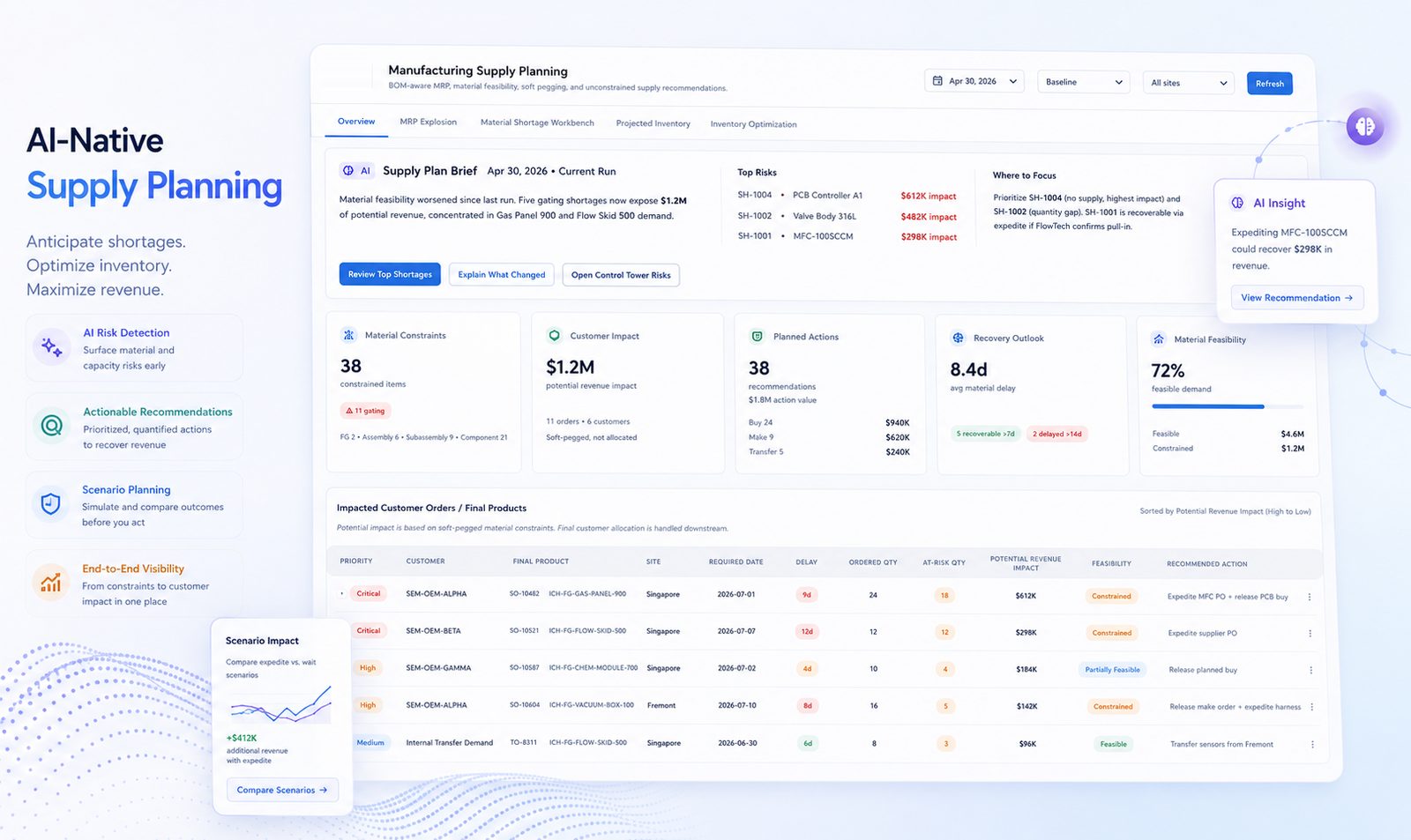
From the demand plan to a funded, feasible supply plan — and the right inventory to carry it, simulated before a dollar is committed.
For manufacturers: BOM-aware MRP with material feasibility and soft pegging — every component shortage traced to the customer orders and revenue it gates. For brands and distributors: buy and replenishment plans that honor vendor lead times, MOQs, order multiples, and cash constraints, with allocation from your DC to every channel.
Every shortage or exception comes with recovery options — expedite, alternate supplier, transfer, new buy — simulated against projected inventory before you commit, then approved with owners, comments, and a full audit trail.
Recommended stocking policies are simulated on the tradeoff that matters: stockout risk vs. working capital. Understocked and overstocked item-locations surface side by side, with excess & aging exposure and days-of-coverage risk flagged before they become write-offs, markdowns, or lost sales.
Missing lead times, MOQs, suppliers, and planning parameters are flagged per item with a data quality score — so you know which recommendations stand on solid ground and exactly what to fix first.
Once approved, actions return to your working systems. Routine moves can auto-execute within policy thresholds your team sets; everything else waits for a planner.
Supply planning software turns the demand plan into a feasible plan for what to make, buy, move, and hold. For manufacturers, Plantryx is BOM-aware — tracing every component shortage to the customer orders and revenue it gates. For brands and distributors, it produces buy and replenishment plans that honor vendor lead times, MOQs, order multiples, and cash.
Holding the right stock, not just more stock. Plantryx recommends stocking policies and simulates them on the tradeoff that matters — stockout risk vs. working capital — surfacing understocked and overstocked item-locations side by side before they become lost sales or write-offs.
No. Your ERP stays the system of record. Plantryx is the decision layer on top of it — the place where the plan your team actually trusts gets built, instead of the spreadsheets planners use around the ERP today.
Every shortage arrives with recovery options — expedite, alternate supplier, transfer, new buy — simulated against projected inventory before you commit, then approved with owners, comments, and a full audit trail.
Items, BOMs and routings where available, orders, inventory balances, open POs, and supplier lead times. You can start from simple exports — automated data-quality checks flag missing lead times, MOQs, and parameters so you know exactly what's usable on day one.
Most planning teams can't put a number on what their planning gaps cost. That number is exactly what the diagnostic delivers — from a focused data extract, no integration required.