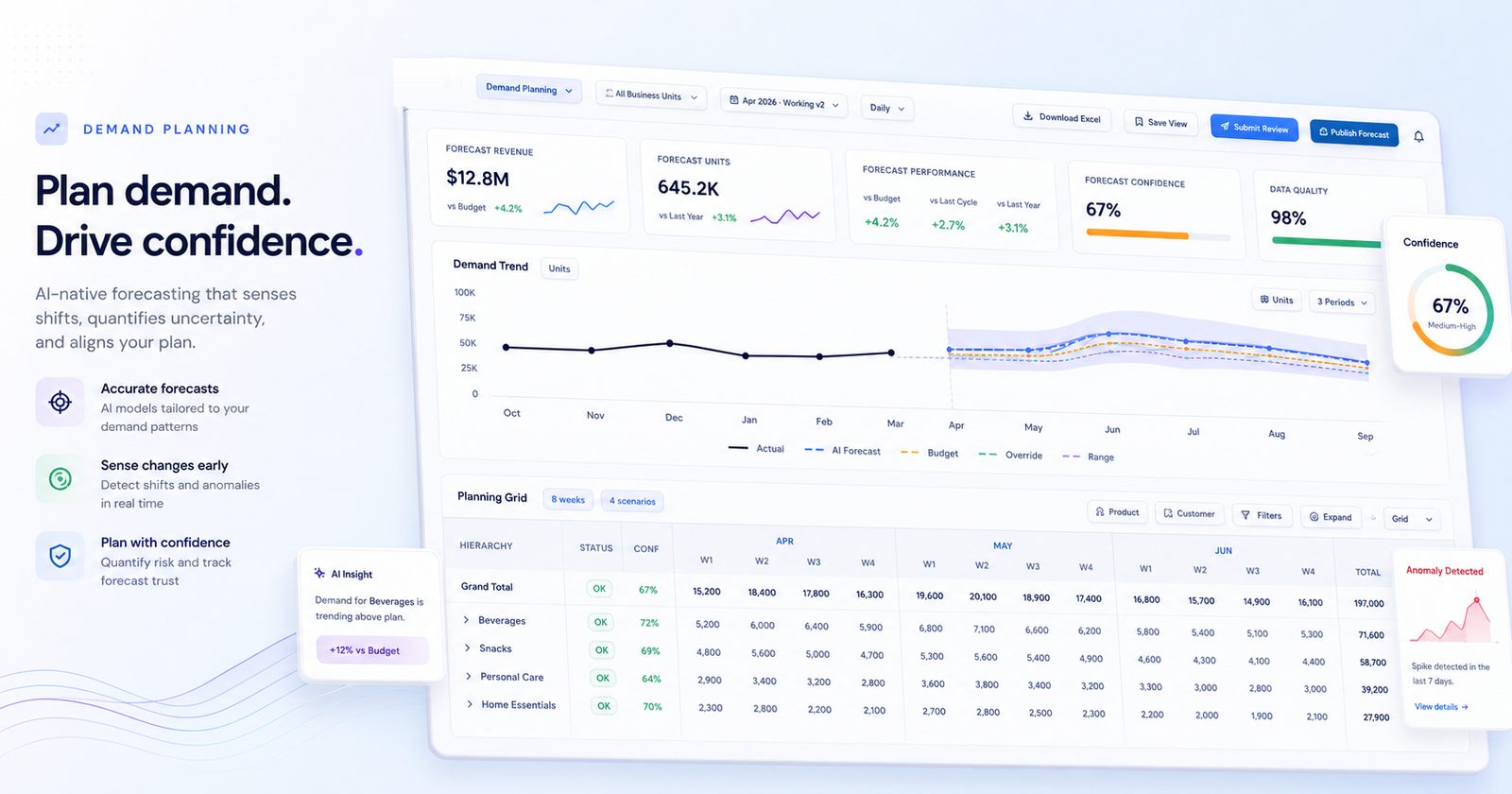
Range forecasts, backed by explainability and confidence — built the way your demand actually works, by customer, channel, and location, with the signals that move it and the scenarios that test it.
The platform detects each item's demand pattern — seasonal, intermittent, trending, lumpy — and applies the best-fit model from a library of 25+ models spanning statistical forecasting, machine learning, and ensembles. Models retrain as new data arrives, so forecasts adapt instead of decaying.
And no single-point guesses: every forecast is a range, backed by a confidence level and explainable drivers — so planners see the uncertainty they're planning against, know when to trust the number, and when to look closer.
AI watches the signals your demand actually moves on. For manufacturers: EDI release volatility, order backlog swings, quote-pipeline changes. For brands and distributors: sell-through and POS, marketplace and web trends, promo response.
Shifts are flagged with their forecast impact, so the plan reacts in the same cycle instead of next month's review.
Build named, non-destructive scenarios on the levers that move your plan — material cost, supplier lead time, and volume for manufacturers; price, cost, and volume for brands — scoped to a supplier, category, or customer. See margin, revenue, and volume impact side by side, run a supply feasibility check, then adopt the winning scenario into the plan with a full audit trail.
Sales, finance, and operations co-own a single plan with role-based workflows. Overrides to the statistical forecast are captured with reasons and impact — accountability without friction, and no competing versions in email.
When an item has no history, the engine builds the launch curve from best-fit analogs across your catalog, then re-forecasts as early signals arrive — so launch inventory is a decision, not a guess.
Demand planning software forecasts what customers will buy so the rest of the business — supply, inventory, finance — can plan against one number. Plantryx builds that forecast per SKU, customer or channel, and location, and turns it into a single consensus plan that sales, finance, and operations actually work from.
Plantryx never gives you one number to blindly trust. Every forecast is a range, backed by a confidence level and explainable drivers — so planners see the uncertainty they're planning against and know when to look closer. That range is also what makes downstream safety-stock and buy decisions honest.
A library of 25+ models spanning statistical forecasting, machine learning, and ensembles. The platform detects each item's demand pattern — seasonal, intermittent, trending, lumpy — and applies the best-fit model per SKU, customer, and location, retraining as new data arrives.
Yes. When an item has no history, the engine builds the launch curve from best-fit analogs across your catalog, then re-forecasts as early signals arrive — so launch inventory is a decision, not a guess.
Weeks, not months. You don't need a live integration to start — begin with a focused data extract, prove the value on your own data, and move to pre-built connectors as it's earned.
Most planning teams can't put a number on what their planning gaps cost. That number is exactly what the diagnostic delivers — from a focused data extract, no integration required.