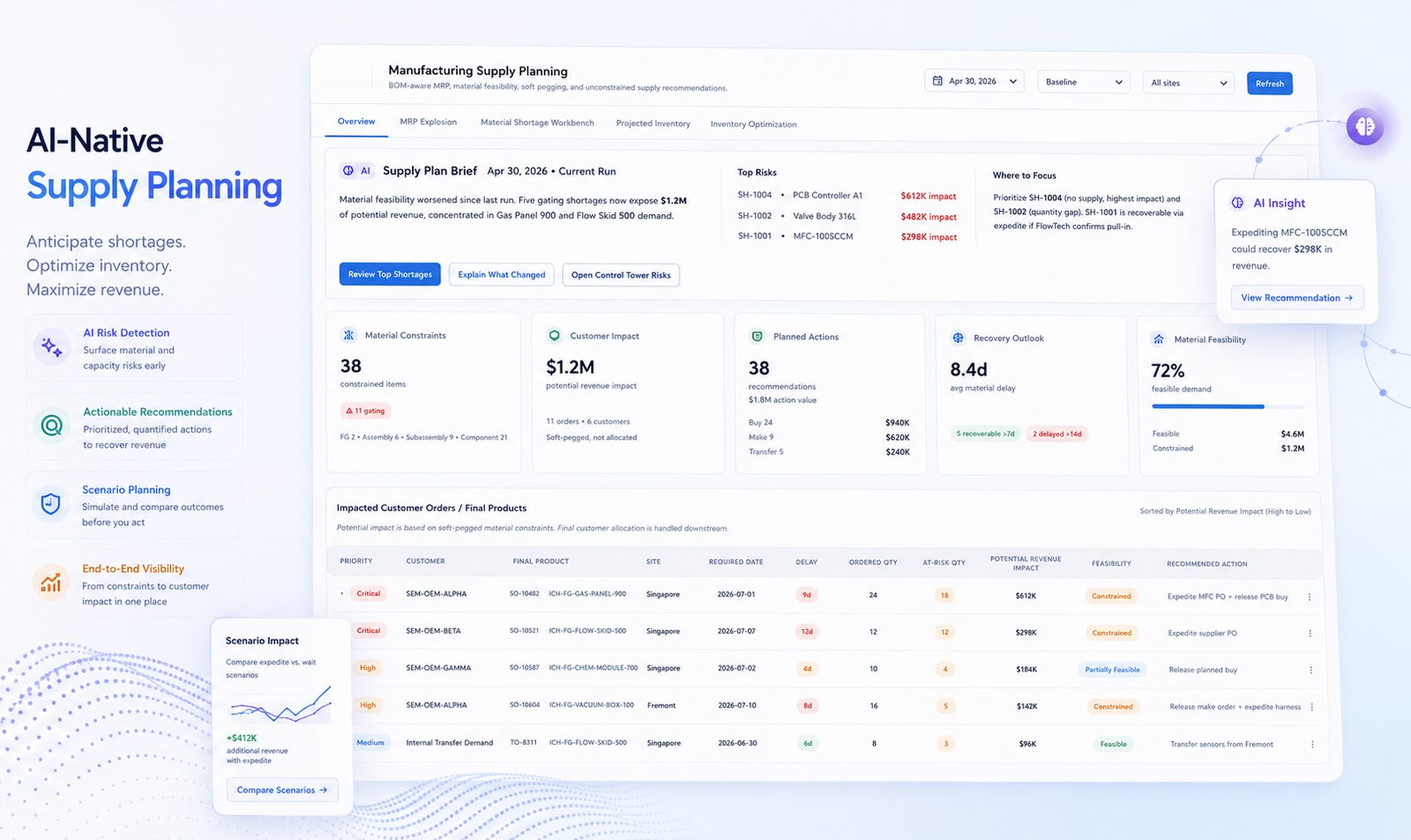
The decision layer on top of your ERP — live in weeks, not months. You run the business on an ERP, yet planning still happens around it, in spreadsheets and tribal knowledge. Plantryx closes that gap with AI-native demand planning, supply planning, and a control tower.
Works alongside the ERPs manufacturers already run: Infor Syteline · Epicor · NetSuite · Microsoft Dynamics · SAP · Plex · Oracle · and others · See all integrations
MRP generates planned orders from static assumptions. When reality shifts, deciding what to actually do still falls to spreadsheets and tribal knowledge. If any of these sound familiar, you're exactly who we built Plantryx for.
Whether your ERP ships planning modules your planners override, or its planning depth is limited and Excel fills the gap — the outcome is the same: the real plan lives in spreadsheets and tribal knowledge, and decisions happen outside the system.
A demand shift or supplier slip today takes weeks to become a supply response. By the time the signal travels through meetings and spreadsheets, the expedite fee is bigger and the customer is angrier.
One late component gates an entire assembly. MRP tells you what's short — not which shortages actually threaten revenue, which orders they hit, or what your best recovery option is.
Pure statistical forecasting misses the demand sitting in your quote pipeline and order backlog. Your planners know this, which is why they override everything by hand.
Planning decisions are too dynamic for static systems — and too cross-functional for disconnected modules.
Three modules that work as one platform — the decision layer above the ERP you already run.
Forecasts built the way manufacturing demand actually works — history, order backlog, and quote pipeline together.
BOM-aware supply planning that doesn't stop at "you're short" — it gets you to a recovered, approved plan.
The executive layer across demand, supply, and inventory — one picture of what changed and what it costs.
Plantryx doesn't ask planners to review everything — it tells them what's worth reviewing, with the analysis already done. The weekly cycle shrinks from days of spreadsheet triage to a ranked queue, and decision lag closes with it.
Every refresh surfaces what changed: demand spikes, supplier slippage, material shortages, promise-date risk, excess building — before they surface in a weekly meeting.
Issues are ranked by business consequence — expected value, urgency, and days to impact — not by who shouts loudest.
Every issue is quantified before anyone opens a spreadsheet: revenue at risk, cost to recover, time to failure.
Each issue carries a recommended action with a confidence score, plus alternatives to compare — owned and worked in one shared workspace.
Approved actions flow back into your workflow. Routine moves can auto-execute within policy thresholds your team sets; everything else waits for a planner.
Most tools bolt a chatbot onto old workflows. Plantryx redesigns the workflow so signals become decisions. Here's specifically where AI does the work — automating friction, never the planner's judgment.
The platform detects each item's demand pattern — seasonal, intermittent, trending, lumpy — and applies the best-fit model from a library of 25+ models spanning statistical forecasting, machine learning, and ensembles. Models retrain as new data arrives, so forecasts adapt instead of decaying. Every forecast is a range backed by a confidence level and explainable drivers — not a single point you're forced to trust.
AI watches the signals manufacturing demand actually moves on — EDI release volatility, backlog swings, quote-pipeline changes — and flags shifts with their forecast impact, so the plan reacts in the same cycle instead of next month's review.
Build named scenarios on the levers that actually move manufacturing plans — a material cost shock, a supplier slipping two weeks, a surge order — scoped to a supplier, product family, or customer. See margin, revenue, and service impact side by side, run a supply feasibility check before committing, then adopt the winning scenario into the plan. Non-destructive and fully auditable.
When AI diagnoses an issue or writes a narrative, every number in it is traceable to a published fact from your ERP — the order, the PO, the inventory position. No black-box scores, no hallucinated impacts. If the data can't support a claim, the platform says so instead of making one up.
Open any flagged issue and the AI co-planner walks you through it: what happened, the evidence behind it, and selectable costed action options. Ask it to generate a recovery plan, draft the supplier expedite message, or write the internal transfer request — then compare tradeoffs and act. In planning meetings, ask it questions in plain language: why a forecast moved, which orders a shortage hits.
The AI recommends and drafts; actions execute only with planner approval — or automatically, within policy thresholds your team has pre-approved.
Planner overrides are logged with reasons and outcomes. AI learns which adjustments improved accuracy — so institutional knowledge compounds in the platform instead of walking out the door with a planner.
Pre-built ERP connectors, out-of-the-box templates, and hands-on onboarding from supply chain practitioners — no multi-quarter implementation, no army of consultants.
Most manufacturers can't put a number on what their planning gaps cost. That number is exactly what the diagnostic delivers — from a focused data extract, no integration required.